




When product or manufacturing costs are too high, cost targets are not being met or an existing product needs to be developed further on a cost-effective basis, it is often not enough to make individual components cheaper in isolation.
In our Value Analysis and Value Engineering projects, we therefore look at customer requirements, functions, technical solutions and costs together. Depending on the task, development, design, procurement, production, product management and other functional departments are involved in a structured process.
The aim is to develop commercially relevant and technically feasible solutions that take both costs and customer value into account – from selecting suitable projects through to implementing and tracking the actions.
When companies talk to us about a Value Analysis project
Our projects do not start with the method but with a specific technical or commercial challenge. Typical situations include:
- Product or manufacturing costs are above target.
- The margin of an existing product is coming under pressure.
- Cost targets of a development project are not being met.
- Cost reduction potential has so far been sought mainly at component level.
- It is unclear which technical features are actually relevant to the customer.
- Product variety, complexity or overengineering are driving costs.
- Development, procurement, production and product management are to work together on cost optimisation.
- A cost reduction project needs a structured methodology and neutral facilitation.
- A decision is needed on which product or product family has the greatest improvement potential.
Which approach makes sense depends on the product, the initial situation and the project objective. That is why, where required, our collaboration begins with a Project Potential Assessment and the selection of suitable projects.
Would you like to discuss your specific challenge?
Every product and every cost reduction project has its own technical, commercial and organisational constraints. In a personal initial consultation, we can look together at the challenge you are facing and which approach might make sense for it.
The initial consultation is non-binding.
Our consulting process for Value Analysis and Value Management
From selecting the right project to implementation
It is based on the Value Analysis Work Plan according to VDI 2800 Part 1.
For us, a successful Value Analysis or Value Management project does not begin with Function Analysis or an ideation workshop.
First, it has to be clarified which product or project actually has the greatest potential, which customer requirements are decisive and which commercial and technical objectives are to be achieved.
That is why we support companies along an end-to-end process: from the Project Potential Assessment and the selection of the right project, through structured customer, function and cost analysis, to solution development, evaluation and implementation.
We deliberately work cross-functionally. Depending on the task, development, design, procurement, production, cost estimating, product management, sales and management are involved in the project.
The aim is not the longest possible list of savings ideas. The aim is commercially relevant, technically feasible and internally accepted actions that can then actually be implemented.
Click on a step to expand the details.
1Project Potential Assessment – Identifying the Right Projects
Not every product or assembly is equally suitable for a Value Analysis project.
That is why our collaboration can begin even before the actual project with a Project Potential Assessment.
Together with the client, we screen potential products, product families, assemblies or planned development projects and assess which topics seem particularly suited to a systematic Value Analysis or Value Management project.
For example, we look at:
- current product and manufacturing costs
- existing or expected cost gaps
- margin and competitive pressure
- technical and design complexity
- product variety
- possible overengineering
- strategic importance of the product
- existing customer and market requirements
- technical and commercial scope for change
- available data
- implementation options and resources
The potential projects are then evaluated and prioritised together.
This means the choice does not simply fall on the product currently under the greatest cost pressure. What matters is the balance between commercial potential, need for action, feasibility and the project effort required.
A prioritised selection of suitable Value Analysis projects and a sound basis for deciding which project to launch. A business case is calculated for the selected projects. The Value Analysis methodology and the identified project ideas can then be presented to management.
More: Project Potential Assessment: selecting the right cost reduction projects
2Project Preparation – Setting the Project Up Properly
Once the project has been selected, the actual project preparation begins.
Together with the internal project manager and the relevant experts, the key parameters are clarified before the project starts.
These include in particular:
- identification of the relevant stakeholders
- clear definition of objectives
- definition of project scope and constraints
- composition of the cross-functional project team
- appointment of a suitable steering committee
- identification of possible project risks
- availability of the necessary information
- resources required from the functional departments involved
- responsibilities
- time and workshop planning
An important part of the preparation is information planning.
Together we agree which information is needed at what point and who will provide it. This may include cost information, technical documentation, market and competitor information, customer requirements, test results or volume data.
This allows the project team to use its shared working time specifically for analysis, solution development and decision-making.
A clearly defined project charter with objectives, study scope, team structure, required data and an agreed project plan.
3Customer Phase – Understanding What Really Matters to the Customer
Before we optimise a product technically or discuss cost reduction measures, we address a fundamental question:
From the customer’s point of view, what actually determines the value of the product?
Value Analysis therefore deliberately does not start with individual components or spontaneous savings ideas. First, we jointly build a structured understanding of customers, market, requirements and competition.
Defining customer groups and segments
In the first step, we identify and discuss the relevant customer groups and market segments.
Depending on the product, requirements can differ significantly by customer type, application, region, market, product class or operating situation.
A general statement about what “the customer” expects is therefore often not sufficient.
We look specifically at:
Which customer or segment expects which performance from the product?
Identifying key buying criteria
We then work out the criteria and customer needs that are actually decisive for purchase in each customer group.
Among other things, we distinguish between:
- mandatory must-have criteria
- differentiating desired criteria
- additional benefit features
- technical or regulatory requirements
This shows which characteristics are actually required and where the product may offer features that the customer perceives or values only to a limited extent.
Weighting customer requirements
Not every requirement is equally important to every customer.
The key buying criteria are therefore systematically weighted for the relevant segments.
This creates a shared and transparent basis for later technical decisions.
Instead of statements such as “The customer needs this”, the project team can discuss more specifically:
For which customer is this characteristic important – and how important is it compared with other criteria?
Including market and competition
The company’s own products are then compared with the relevant competitor products or alternative solutions.
Depending on the task, we look at aspects such as:
- fulfilment of the key customer requirements
- technical performance attributes
- market position
- product variants
- differentiating features
- identifiable over- or under-fulfilment
- costs or price position
- possible competitive advantages
A structured value-versus-cost assessment shows where a product offers relevant added value and where effort may be expended without any corresponding additional benefit from the customer’s point of view.
Depending on the task, scorecards, portfolio charts or bubble charts can be used for this, among other tools.
Deriving the further project work
At the end of this phase, the project team has a shared understanding of
- which customers and segments are being considered,
- which criteria are actually decisive for purchase,
- how important these requirements are,
- how the company’s own product is positioned against the competition,
- where there is potential for differentiation and
- which areas should be examined more closely as the project continues.
A robust customer- and market-based foundation for the subsequent Value Analysis. Technical and commercial decisions can then be aligned specifically with the customer requirements that are actually relevant.
4Function Analysis – From the Existing Product to the Actual Task
Based on the customer requirements, we then look at the functions of the product.
The initial focus is not on the individual components but on the question:
Which functions must the product and its individual parts perform?
A component is a technical solution that usually performs several functions. At the same time, several components can contribute jointly to performing one function. In Function Analysis, we therefore abstract from the existing design and describe systematically which tasks actually have to be performed.
Instead of asking only:
“How can we make the individual components cheaper?”
we first consider:
“Which functions do the individual components perform, which of them are required, and are there other ways of performing them?”
This does not call the existing solution into question as a matter of principle but adds a functional perspective. In this way, both improvements to the existing design and alternative solution approaches can become visible.
In addition to the functions of individual components, we look at the functions of the product as a whole and how they are interrelated. The functions are described, structured and related to one another.
A shared, solution-neutral understanding of which functions the product has to perform – as a basis for further cost analysis and solution development.
5Function Cost Analysis – Understanding Where the Money Goes
Conventional cost accounting shows very well how much each component costs.
For Value Analysis, however, a different question is also of interest:
What costs arise from performing a particular function?
The existing product or manufacturing costs are therefore allocated to the functions defined previously.
This creates a link between:
customer value – function – technical solution – costs.
Function Cost Analysis shows
- which functions cause particularly high costs,
- where the cost focal points in the product lie,
- for which functions costs and importance may be out of proportion,
- where overengineering exists and
- which functions are of particular interest for further work.
This is precisely a key difference from pure component cost analysis.
A component can be plausibly costed in its own right and still be part of a very expensive function whose performance should be fundamentally questioned.
Transparency about the key function costs and a sound basis for selecting the commercially relevant areas for optimisation.
More: Function Cost Analysis
6Defining focus areas and opportunity areas
The key opportunity areas for solution development are then derived from customer requirements, functions, function costs, and market and competitor information.
As a result, the project team does not spread its attention indiscriminately across the entire product.
Instead, work is targeted where there is a relevant relationship between
customer value, costs, technical effort and potential for change
.
Typical questions may include:
- Can functions be performed more simply?
- Are functions being performed to a greater extent than the customer needs?
- Can several components or functions be combined?
- Are variants really necessary?
- Are there alternative technical principles?
- Can standards be used more extensively?
- Can materials or manufacturing processes be changed?
- Can bought-in parts or supplier solutions be used?
- Are there better solutions among competitors or in other technical fields?
Clearly prioritised opportunity areas and specific tasks for the subsequent creativity phase.
7Solution Development – Deliberately Opening Up New Solution Spaces
Only now does the systematic creativity phase begin.
This sequence is important: first, customer requirements, functions, costs and opportunity areas have been understood. New solutions can then be developed in a targeted way.
In facilitated ideation workshops, the cross-functional team develops alternative ways of performing the prioritised functions.
In doing so, we deliberately and repeatedly try to steer the discussion away from the technical details of the existing design.
The central question is:
“How else could this function be performed?”
and not merely:
“How can we make the existing solution a little cheaper?”
This often leads to considerably more far-reaching approaches.
Possible ideas may concern, for example:
- alternative technical working principles
- design simplifications
- standardisation
- component integration
- variant reduction
- material changes
- alternative manufacturing processes
- modified tolerances
- bought-in parts and supplier solutions
- modularisation
- make-or-buy approaches
- eliminating existing technical solutions entirely
The cross-functional composition of the team is an important part of the approach. Development, procurement, production and other functional departments look at the same task from different perspectives.
A broad range of alternative solution approaches for the prioritised functions and cost focal points.
8Evaluating and detailing solutions and preparing them for decision
Ideas alone do not yet create any commercial benefit.
The solution approaches developed are therefore systematically evaluated in the next step.
Depending on the task, we consider aspects such as:
- expected customer value
- possible cost-saving potential
- technical feasibility
- development effort
- investment required
- implementation time
- risks
- quality impact
- impact on production and the supply chain
- organisational feasibility
Not every interesting idea is pursued immediately.
The most promising approaches are prioritised and then detailed further from a technical and commercial perspective.
In this way, initially rough ideas become solution concepts that can be evaluated.
This also reveals what information is still missing. These open points are assigned as specific work packages to the responsible functional departments and dealt with between project meetings.
The results are then fed back into the joint evaluation.
Prioritised and detailed solution concepts with a transparent evaluation of benefits, costs, effort, risk and feasibility.
9Implementation – Turning Potential into Results
A Value Analysis project should not end with the selection and evaluation of the best concepts. What matters is that identified potential actually turns into implemented, commercially effective actions.
That is why it pays to continue supporting implementation with the cross-functional project team. The selected actions are converted into specific implementation packages. For each package, responsibilities, necessary technical work, decisions, due dates and next steps are defined.
Reviewing implementation and potential regularly
In regular implementation reviews, the team checks together:
- What is the current status of the actions?
- Is the originally identified potential still achievable?
- What commercial impact is actually emerging?
- What technical or organisational problems have arisen?
- Where is corrective action needed?
This is not just about formally ticking off tasks. What matters is whether the planned actions actually achieve the expected impact.
If difficulties arise during implementation, a fundamentally good idea should not be discarded too hastily. Instead, the team analyses together why implementation has stalled and how the solution can be adapted or developed further.
This creates a continuous cycle of implementation, review and targeted corrective action.
It is important to distinguish clearly between:
identified potentialevaluated conceptapproved actionimplemented solutionrealised commercial impact
Because only implementation shows which potential is actually realised.
Clear implementation packages, defined responsibilities and regular tracking of actions and commercial impact – with active corrective action when technical or organisational obstacles arise.
Would you like to see how this approach could be applied to your product?
In a personal conversation, we can discuss your initial situation, possible project objectives, the data available and the composition of a suitable project team. We can also clarify whether a Value Analysis project makes sense straight away or whether a Project Potential Assessment should come first.
How does a Value Analysis project work in practice?
In this video, Dr.-Ing. Jörg Marchthaler uses a real Value Analysis project to explain how a Value Engineering project can be structured, which project phases it goes through and how a cross-functional team is guided methodically from analysis to implementable solutions.
It gives you not only an insight into the methodology but also an impression of how Dr.-Ing. Jörg Marchthaler facilitates Value Analysis projects and guides project teams through the structured process.
Project work means more than workshop facilitation
Our Value Analysis projects do not consist of individual, unconnected workshops.
Instead, the project meetings provide the shared framework in which results are brought together, decisions are made and the next steps are defined.
Between meetings, the responsible departments work on specific work packages.
For example:
- costs are examined in detail
- technical variants are checked
- suppliers are approached
- calculations are carried out
- tests are prepared
- designs are developed in more detail
- market information is added, or
- economic feasibility calculations are prepared
The results of this work are evaluated jointly at the next project meeting and form the basis for further decisions.
This way of working continues during implementation: actions are tracked, results are reviewed and, if obstacles arise, solutions are developed further together.
As a result, our approach combines structured workshop work with the actual technical and commercial project work in your company – from the initial analysis through to implementation.
Our aim: improving value, not just reducing costs
For us, Value Analysis is not simply a cost reduction method.
At its heart is the question:
How can the functions the customer needs be delivered with an economically optimal level of effort?
This deliberately links costs and customer value.
It makes it possible to challenge technical complexity and overengineering without indiscriminately removing performance from a product.
At the same time, it creates a shared basis for decisions by R&D, procurement, production, product management and management.
Our goal, therefore, is not as many ideas as possible or impressive workshop presentations.
Our goal is:
technically sound, commercially relevant and actually implemented actions.
When does a Value Analysis or Value Engineering project make sense?
A full Value Analysis project is particularly worthwhile when the aim is not just to optimise individual purchase prices or components, but when product, functions, customer requirements and costs need to be examined together.
Typical starting points include high cost or margin pressure, missed cost targets, considerable scope for technical change, high product or variant complexity, or the need to involve several departments jointly in developing solutions.
Value Engineering can also be applied to new products in order to link customer requirements, functions and target costs at an early stage.
When is a smaller approach better to start with?
Not every cost issue immediately requires a full Value Analysis project. If, for example, it is solely about a clearly defined purchase price or a single technical measure that is already known, a more focused approach may be sufficient.
That is why we clarify at the outset what the actual problem is and what project scope is appropriate for it.
If there are several possible products or projects, a Project Potential Assessment can be carried out first.
Not sure yet which product is suitable for a Value Analysis project?
This is exactly what the Project Potential Assessment is for.
Together, we screen and evaluate possible products, product families, assemblies or development projects and identify the topics where a Value Analysis or Value Management project appears particularly worthwhile.
Examples from real Value Analysis and Value Engineering projects
Value Analysis projects differ depending on the product, industry, initial situation and project objective. The following examples show three different applications of our approach.


Glen Dimplex Deutschland – optimising costs and customer value together
The Value Engineering project combined competitor analysis, a product clinic, Function Cost Analysis and the creativity, evaluation and concept phases.
The project work produced several viable product concepts. For two of these concepts, cost reduction potential of more than 30% each was identified, while, according to the company, customer value was improved by up to 10% at the same time.


Motan – reducing costs, integrating functions and consolidating variants
The project focused on reducing costs, improving functionality and consolidating existing variants.
Among other things, the cross-functional team worked with customer requirements, Function Analysis, function cost analysis and concept development. According to the company, manufacturing costs were reduced by up to 39%, depending on the product variant, while new functions were integrated at the same time.

thyssenkrupp Automation Engineering – Value Analysis in special-purpose machine building
At thyssenkrupp Automation Engineering, Value Analysis was first used in pilot projects to reduce manufacturing costs and create additional customer value.
A key focus was repeatedly steering the cross-functional team away from detailed technical discussions and back to the essential functions and project objectives. The company rates the project results positively and subsequently planned further collaboration.
More project examples
Value Coaching Marchthaler has supported Value Analysis, Value Engineering and Value Management projects in a wide range of industrial companies.
What potential does your product hold?
The results of other projects cannot automatically be transferred to a different product. The potential that actually exists depends on the specific initial situation.
In a personal conversation, we can look together at which question is central for you and what a sensible first step might look like.
Our services
Whether product development, product optimisation or process optimisation: we help you develop and implement lasting improvements. We advise companies in a wide variety of industries and work with you to examine and evaluate things from new perspectives.
Our services in detail: Systematic Product Cost Reduction · Cost Reduction Project and Cost Reduction Workshop · Project Potential Assessment
In detail, we offer:
- Developing a strategy for introducing the relevant method in your company.
- Information sessions for employees and management.
- Initiating, organising and running a pilot project.
- Planning and running your Value Analysis projects on site at your company.
- Monitoring and reviewing actions.
- Coaching employees during the project.
- Facilitator qualification programmes.
- Coaching trained facilitators in follow-up projects.
We have specialists for:
- Value Analysis
- Value Management
- Agile Value Analysis
- Agile Product Development
We would be happy to show you in a preliminary meeting how, together with your employees, we can create benefits for your company.
Simply get in touch by email or phone. Discuss your requirements and ideas with us.
We look forward to your call or email.
Would you like to find out more first?
Webinar: get to know Value Analysis and the approach in detail
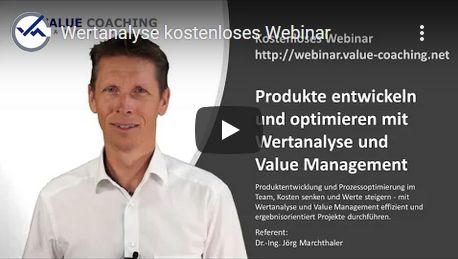
Would you like to explore the methodology in more depth before a personal conversation? In the free recording of our webinar, which lasts around one hour, Dr.-Ing. Jörg Marchthaler introduces Value Coaching and explains the success factors of Value Analysis, the methods used, how they interact and ways of introducing them in your company.
Free checklist for development and cost reduction projects

With our free checklist, you can check how systematically product development and cost reduction projects are already set up in your company.

Your contact for Value Analysis and Value Engineering projects
Dr.-Ing. Jörg Marchthaler supports industrial companies in Value Analysis, Value Engineering and Value Management projects and facilitates cross-functional project teams from analysis through to the development and implementation of concrete actions.
You will find more information on his professional background, roles, publications and areas of expertise in the detailed expert profile.
Frequently asked questions about Value Analysis consulting
How does a Value Analysis project start?
At the start, the initial situation, project objective, study scope, relevant stakeholders and available information are clarified. If there are several possible projects, a Project Potential Assessment can be carried out first.
Which departments should be involved in a Value Analysis project?
The composition depends on the product and the task. Typically, R&D or design engineering, procurement, production, product management, cost estimating and other relevant departments work together in the project team.
What information is needed before the project starts?
Depending on the project, this may include cost information, technical documentation, unit volumes, market and competitor information, customer requirements and existing test results. Which data is actually required is agreed jointly during project preparation.
Can Value Analysis also be used for new products?
Yes. Value Engineering can be applied during product development to link customer requirements, functions, technical solutions and target costs at an early stage.
Is a Value Analysis project only about cost reduction?
No. The aim is not to cut functions across the board. Customer requirements, required functions and costs are examined together. This can lead to approaches for cost reduction as well as for value improvement and product development.
Who facilitates the project?
Depending on the task and scope, projects are supported and facilitated by Value Coaching. Dr.-Ing. Jörg Marchthaler is responsible in particular for leading the project methodologically and facilitating cross-functional teams.
Does Value Coaching also support implementation?
The project work can continue beyond the analysis and concept phase into implementation. Actions, responsibilities and financial impact can be reviewed regularly and, if obstacles arise, developed further together.
When is a Value Analysis project worthwhile?
A Value Analysis project can be particularly worthwhile when product or manufacturing costs are too high, cost targets are not being met, or technical complexity and product variety are increasing. Before the project, it should be checked how great the pressure to act, the potential and the scope for change actually are.
How long does a Value Analysis project take?
There is no standard duration. It depends on product complexity, project scope, the data available and the technical detailing required. The joint workshops are only one part of the overall project.
What happens after the workshop?
Prioritised ideas are turned into concrete concepts and actions. Responsibilities, technical tasks and due dates are defined, and implementation is tracked in reviews.
When does an external facilitator make sense?
External facilitation can be particularly helpful for pilot projects, conflicting objectives across departments, or when internal methodological competence is still limited.
Further reading: All Frequently Asked Questions about Value Analysis and Value Engineering
Let’s talk about your challenge
Do you want to reduce product or manufacturing costs, develop an existing product further, or first find out which projects have the greatest improvement potential?
In a personal initial consultation, we discuss your initial situation and clarify which next step may make sense for your task.