


Cost reduction and development projects rarely fail because there are no ideas at all. More often, there is no common approach: each department looks at the product from its own perspective, solutions are discussed too early and decisions are made before requirements, functions and costs are sufficiently understood.
The Value Analysis Work Plan provides a structured approach to address this.
It guides a cross-functional team step by step from preparation through analysis and the development phase to decision and implementation. As a result, Value Analysis does not become a collection of individual methods, but a coherent project process.
The VDI describes this procedure in VDI 2800 Part 1. The following overview shows the procedure in simplified form, but follows the terminology and numbering of steps 0 to 9 of the Value Analysis Work Plan.
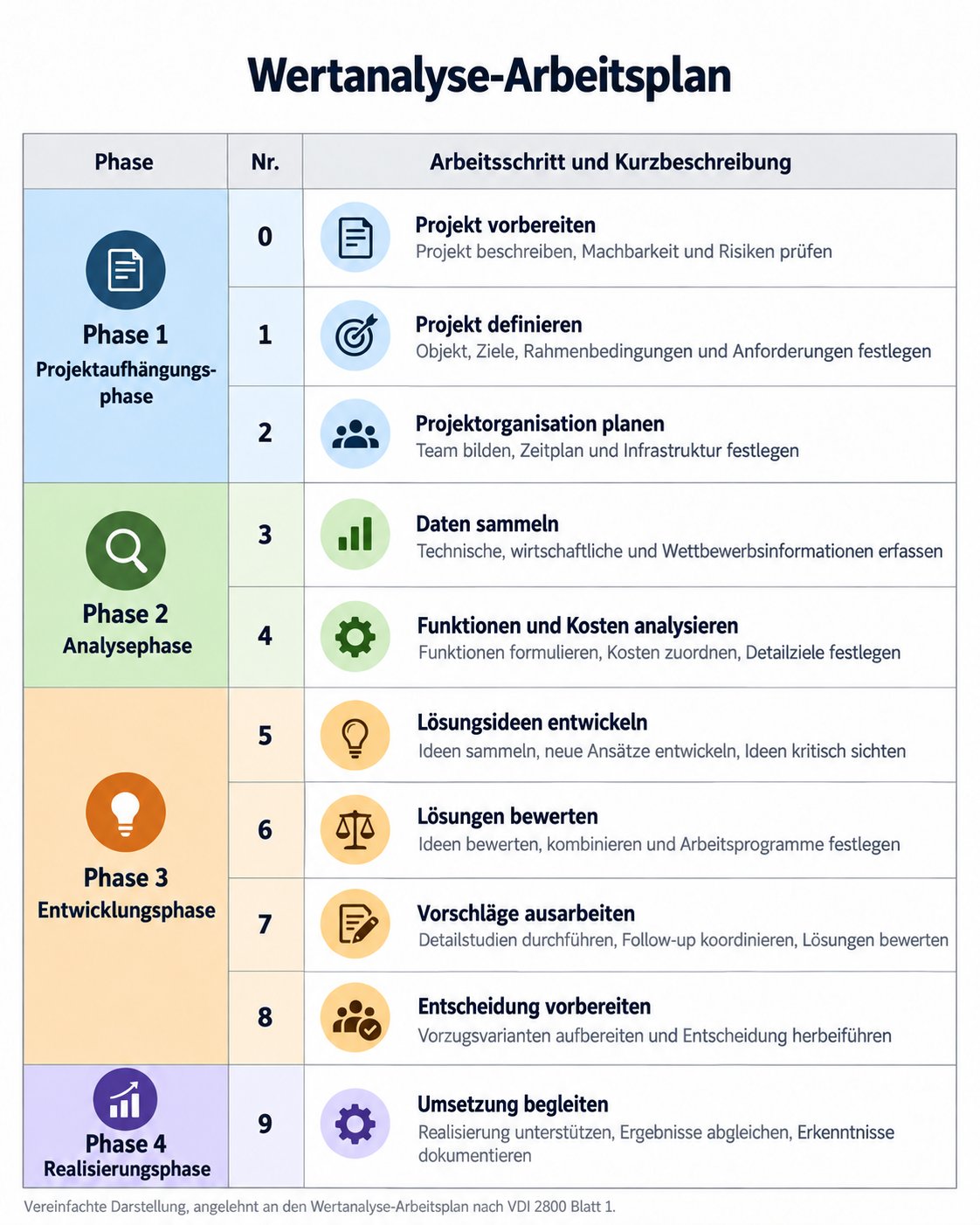
Why a work plan matters in Value Analysis projects
In complex products, costs result from many decisions at the same time. Development, procurement, production, quality, product management and sales each have different information and different objectives.
Without a clear sequence, typical problems arise:
- Solutions are discussed before the problem is understood.
- Individual components are optimised without questioning their functions.
- Costs are considered without taking customer value into account.
- Ideas are generated without clear opportunity areas.
- Actions are evaluated even though their effects have not been adequately described.
- good ideas are left without an owner or implementation after the workshop.
The work plan does not prevent such problems automatically. It does, however, create a common framework in which the necessary questions can be addressed in a sensible order.
Procedure according to the Value Analysis Work Plan
The procedure is described below on the basis of steps 0 to 9. The names, numbering and sub-steps follow the representation of the Value Analysis Work Plan to VDI 2800 Part 1 used in the project.
Phase 1: project initiation phase
Step 0: prepare the project
Step 0 serves to turn an initial project idea into a viable undertaking. Here, the project is first described, checked for basic feasibility and assessed in economic terms.
This step includes in particular:
- 0.1 Describe the project (outline)
- 0.2 Examine the feasibility of the project, analyse risks
- 0.3 Prepare a profitability study, clarify interests
- 0.4 Select decision-makers and the VA project manager
In practice, this means that the project is first described as an outline, examined for feasibility and combined with an initial risk analysis. It is also clarified whether the undertaking makes economic sense and whether the interests of those involved support it. Finally, the decision-makers and the VA project manager are appointed.
Step 1: define the project (final)
In Step 1, the project is finally delimited and its content defined. The VA object is now clearly described and the scope of the study is defined bindingly.
This step includes in particular:
- 1.1 Describe the VA object (final)
- 1.2 Define evaluation criteria, scope of the study and constraints for the project
- 1.3 Identify existing needs, problems, trends, structures etc., define the required detailed objectives
- 1.4 Define market-oriented objectives
- 1.5 Formulate and approve general objectives (high-level objectives)
- 1.6 Review and define strategic and economic importance
- 1.7 Identify resource requirements, ensure availability
- 1.8 Appoint and inform participants
- 1.9 Analyse project and product risks (as the basis for the risk analysis accompanying the project)
In this step, therefore, not only is the study object finally defined. Evaluation criteria, boundaries and constraints are also determined. In addition, existing needs, problems and trends are systematically examined, market-oriented objectives and high-level objectives are defined, and strategic and economic importance is reviewed. At the same time, it must be clear which resources are needed, who is involved and which risks affect the project or the product.
Step 2: plan the project organisation (structure and workflow)
Once the content of the project has been defined, the organisational basis is established. The aim is to enable the team to work effectively and to set a viable organisational framework.
This step includes in particular:
- 2.1 Form the working team
- 2.2 Draw up an initial schedule
- 2.3 Define infrastructure – workspace, equipment …
In practice, this means that the working team is put together, an initial schedule is drawn up and the necessary infrastructure is defined. This includes, for example, the workspace, equipment and the organisational prerequisites for collaboration.
Phase 2: analysis phase
Step 3: collect comprehensive data on the object
In the analysis phase, the team systematically collects the necessary information about the study object. The aim is a shared and reliable understanding of the initial situation.
This step includes in particular:
- 3.1 Gather information
- technical information, state of the art
- economics
- competitors
- 3.2 Research the market in detail
- the market, customer requirements
- determining the position of the product to be developed
In other words, the team gathers technical and economic information, takes account of the state of the art and analyses relevant competitors. In addition, the market is researched in detail. This includes, in particular, customer requirements and the question of which market position the product being developed or studied should occupy.
Step 4: analyse functions and costs / define detailed objectives
Step 4 is part of the methodological core of Value Analysis. Here the product is examined not only in terms of its components but, above all, in terms of the tasks it has to perform.
This step includes in particular:
- 4.1 Formulate needs and analyse functions
- 4.2 Analyse Costs, Allocate Costs to Functions (Function Cost Analysis)
- 4.3 Define detailed objectives and evaluation criteria
First, needs are formulated and translated into functions. Building on this, the team analyses which costs are associated with these functions. This is precisely where Function Analysis and Function Cost Analysis come together. The detailed objectives and evaluation criteria that will govern the subsequent development and evaluation of solutions are then defined.
To weight evaluation criteria or other items to be assessed in a transparent way, the weighted paired comparison can be used, for example.
Phase 3: development phase
Step 5: gather and develop solution ideas
Building on the analysis, the actual creative work now begins. The aim is to find alternative ways of performing the required functions.
This step includes in particular:
- 5.1 Gather existing ideas
- 5.2 Develop new ideas
- 5.3 Critically analyse the pool of ideas
First, ideas that already exist are gathered. New ideas are then developed in a targeted way. Finally, the pool of ideas is critically analysed to sharpen the direction for further work.
Step 6: evaluate solution ideas
After the ideation phase, the proposals are evaluated, combined and prioritised in a structured way. This turns a large number of individual ideas into a manageable selection.
This step includes in particular:
- 6.1 Evaluate and combine ideas
- 6.2 Select and define tasks, e.g. for development …
- 6.3 Define work programmes, e.g. for development …
In this step, the ideas are not only assessed but also combined with one another. Specific tasks are then selected and defined, for example for development. This results in work programmes that prepare the next stage of work in a structured way.
Step 7: develop comprehensive proposals, select a solution
The prioritised solution directions are now explored in greater depth and worked up into robust proposals. The aim is to develop viable solution options and to review them from technical, economic and risk perspectives.
This step includes in particular:
- 7.1 Carry out detailed studies, industrial development, …, tests
- 7.2 Carry out follow-up, coordinate actions
- 7.3 Evaluate solutions
- qualitatively
- economically
- risk analysis
In other words, detailed studies and, where necessary, further development and testing activities are carried out for selected solution directions. At the same time, the necessary actions are coordinated. The solutions are then evaluated qualitatively, economically and in terms of risk.
In concept development, suitable solution elements are combined into comprehensive, comparable solution concepts.
The alternative solutions developed can then be compared systematically with a utility analysis using weighted evaluation criteria.
Step 8: present proposals, obtain a decision
The proposals developed are now prepared so that the decision-makers can make a well-founded decision.
This step includes in particular:
- 8.1 Work out the solutions to be proposed
- 8.2 Work out implementation programmes
- 8.3 Structure and present comprehensive data on the proposals
- 8.4 Obtain a decision from the decision-maker
- 8.5 Inform the VA Teams, Decide Whether the VA Team Is Disbanded or Put on Standby
In this step, the solutions to be proposed are therefore finalised and linked to implementation programmes. The information on the proposals is presented in a structured way so that the decision-makers can decide on a sound basis. The VA teams are then informed of the outcome, and it is decided whether the team is disbanded or remains on standby.
Phase 4: implementation phase
Step 9: implement the proposals and decision
In the final step, implementation is actively supported and the results achieved are reviewed. This means that Value Analysis does not end with a list of ideas, but with practical implementation and lessons learned for future projects.
This step includes in particular:
- 9.1 Support implementation
- follow-up
- support the correction of deviations
- 9.2 Hold further team meetings (in exceptional cases)
- 9.3 Compare actual results with forecasts
- 9.4 Communicate results achieved, technical and general information
- 9.5 Set up a system for collecting information on
- the behaviour of the product in use
- experience with the VA methodology
Implementation is supported, deviations are corrected and – if necessary – further team meetings are held. In addition, actual results are compared with the forecast results. The technical and general information gained is communicated. Finally, a system is set up for collecting both experience from the use of the product and experience with the VA methodology.
The work plan is not a rigid recipe
The Value Analysis Work Plan provides structure, but it must not be confused with working through steps mechanically.
Products, companies and project objectives differ. The depth of analysis, the methods used and the focus over time can therefore vary.
The common thread, however, remains important:
Phase 1Project initiation phase
Phase 2Analysis phase
Phase 3Development phase
Phase 4Implementation phase
The Value Analysis Work Plan at Value Coaching
In Value Coaching consulting projects, the structured process is adapted to the specific project situation. The aim is not to apply methods for their own sake, but to link the necessary steps in such a way that the project team can make transparent decisions and develop solutions that can be implemented.
Documented reference projects show that this involves linking customer requirements, Function Analysis, Function Potential Analysis, function-cost analysis, idea development, evaluation, concept development and implementation, among other things.
Further reading
- Roles in a Value Analysis project
- Detailed objectives and evaluation criteria
- Risk analysis in Value Analysis projects
- What are Value Analysis / Value Engineering and Value Management?
- Function Analysis: looking at tasks instead of components
- Function Cost Analysis: allocating costs to functions
- Function Potential Analysis: prioritising opportunity areas
- Creativity in Value Analysis and TRIZ
- Evaluation in Value Analysis: prioritising ideas transparently
- Implementation: turning ideas into effective actions
- Cost reduction project and cost reduction workshop
- Value Analysis project examples and references
- VDI 2800 Part 1 – Wertanalyse (Value Analysis) (VDI)