What are Value Analysis and Value Management?
The concept of Value Management is based on a particular concept of value. This concept holds that there is a relationship between the satisfaction of many different needs and the resources used to satisfy them. The fewer resources that need to be used, the higher the value. The various interest groups, known as stakeholders, or internal and external customers, naturally hold widely differing views on what value means.
The aim of Value Management is to harmonise these differences and bring them into line with one another. This method is intended to give an organisation the lasting ability to make the greatest possible progress towards its defined objectives, while using a minimum of resources. DIN EN 12973 defines Value Management as follows:
Value Management is a style of management particularly dedicated to mobilising people, developing skills and promoting synergies and innovation, with the aim of maximising the overall performance of an organisation.
Value Management can be implemented at different organisational levels. At management level, Value Management is based on a value-oriented organisational culture that takes into account the value for the various stakeholders and customers.
At operational level, particularly in project-based activities, Value Management includes a wide range of tools and methods for achieving the desired result.
Value Management addresses management objectives holistically, promotes positive human dynamics and takes internal and external environmental conditions into account.
Value Management comprises three principles:
- Constant awareness of what value means for an organisation. Key figures (measured or estimated values) should be established for monitoring and control.
- A focus on objectives and targets before solutions are sought.
- Functional thinking in all areas to maximise innovative and practicable results. This means focusing not on objects or processes themselves, but only on their effect.
Some examples of where the application of Value Management can achieve visible success:
- Better business decisions by creating a sound basis for decision-making.
- Greater effectiveness through the best possible use of limited resources.
- Improvement of services and products through the complete capture and correct weighting of customer needs.
- Greater competitiveness by promoting innovation.
- A shared value culture that gives all employees a better understanding of the organisation's objectives.
- Improved communication and performance through multidisciplinary teamwork.
- Decisions can be developed that are supported by all stakeholders.
When Value Management is applied to project-based development, the structured approach leads to greater effort in the early phases (see Figure 1). Compared with conventional project management, more time has to be invested in the concept phase. Whether or not the cumulative effort is lower than with conventional project management is of secondary importance here.
The clear advantage is that, with Value Management, planned market launch dates can be met more easily. In the best case, the individual project phases are even shortened. This brings enormous advantages, especially in highly competitive market segments, because the later the market launch, the lower the profit margin.

Figure 1: Application of Value Management in development
Value plays a central role in Value Management. This is already evident in the language. In German, “Wert” is a general term. In the English-speaking world, by contrast, a distinction is made between “worth” and “value”. Value corresponds to an equivalent, e.g. in goods for exchange, services or similar. Worth, on the other hand, describes a qualitative assessment of something. This distinction clearly shows how value is understood in Value Management. Here, value is the relationship between the satisfaction of needs and the resources used to achieve this satisfaction (see Figure 2).

Figure 2: definition of value
What distinguishes Value Management from other management styles is that it simultaneously incorporates certain attributes that are not normally found together. These essential factors are also known as “soft success factors”. They help to make the use of Value Management effective.
The methodology combines the following elements in a single system (see Figure 3):
- Management
- Positive human dynamics (behaviour)
- Consideration of external and internal environmental factors
- Effective use of methods and tools

Figure 3: success factors of Value Management
Value Management comprises a large number of methods. Value Analysis, the origin of Value Management, is one of the most frequently used tools. An overview of the wide range of possible methods is shown in Figure 4. It makes clear that the methods of Value Analysis form the core of Value Management. Functional thinking, creativity and teamwork are essential components of Value Management.
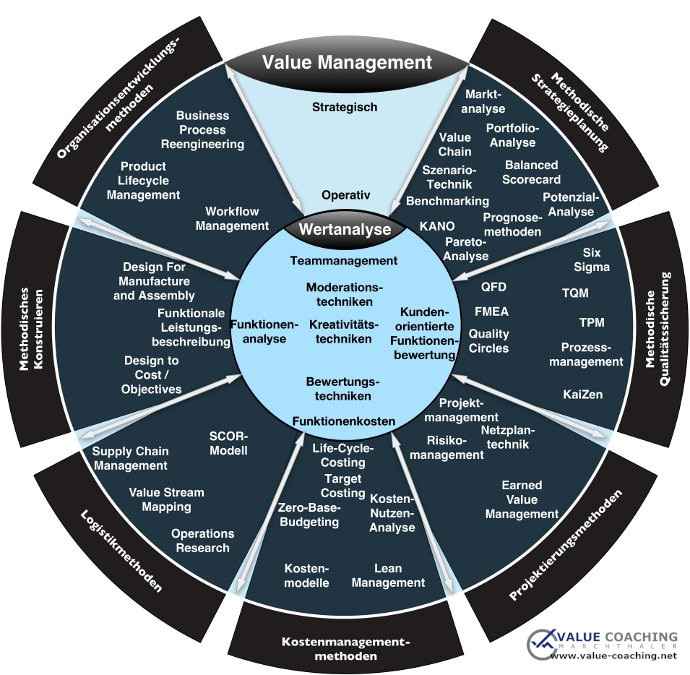
Figure 4: Value Management method pool
Value Analysis
DIN EN 1325-1 defines Value Analysis as an organised and creative approach that uses a function-oriented and economic design process with the aim of increasing the value of a VA object.
According to this definition, Value Analysis is a method for increasing the value of an object. The definition is made more specific by the note that this process should be carried out by a team and structured by a fixed work plan.
All Value Analyses contain the same basic elements. They are governed by a uniform work plan, take a function-oriented view of the objects and work with cross-functional teams. Particular attention is paid to the work plan, as it forms the “common thread” of the analysis.
Objectives of Value Analysis
The primary objective of Value Analysis is to optimise the value of the company, for example through higher profit. This is achieved through lower-cost products and improved processes and services. When Value Analysis is applied to the planning of new products or product ranges, it is referred to as value planning. The application of Value Analysis in the concept phase is called value design. For existing products, by contrast, it is referred to as value improvement.
Value Analysis takes a “holistic view”. The interests and constraints of all areas concerned and of the wider environment are to be taken into account. These include, first and foremost, the satisfaction of user needs, but also economic and environmental regulations imposed by the state or the company, as well as generally accepted standards and values. The holistic view therefore extends the range of framework conditions to be considered.
The work plan
The core of the method is the work plan to be applied. Following a strict procedure (the work plan) has the advantage of transparency for everyone directly and indirectly involved.
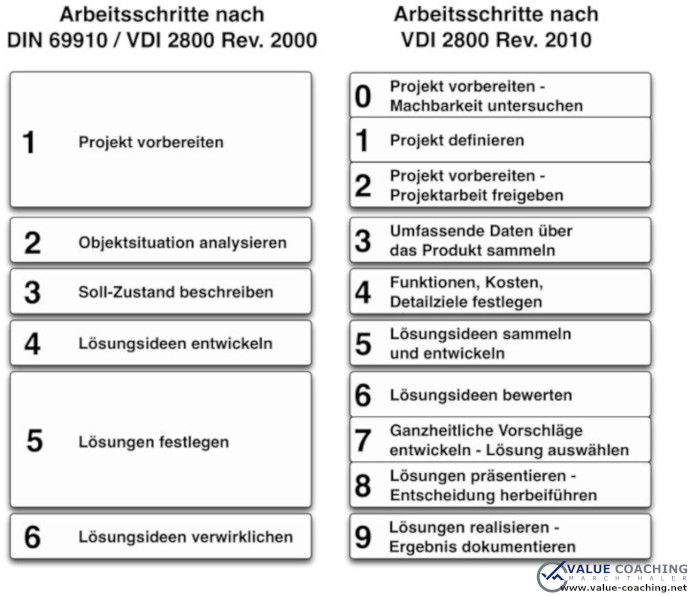
Figure 5: Value Analysis Work Plan from VDI 2800 (2000) and VDI 2800 (2010)
The most widely used work plan for Value Analysis in Germany at present is the 6-step work plan from VDI 2800 (2000). However, in the course of standardisation at European level, it was extended in 2010 when the VDI 2800 guideline was updated.
The process starts with taking over the described project. If the objects under consideration are extended in a strategic and commercial direction, upstream analyses are essential to place the object in a meaningful context and increase the chances of successful implementation. This includes not only describing the object but, above all, high-level feasibility analyses intended to clarify purpose and urgency as well as opportunities, risks and expected effects on the market. Only when all preparations relating to the object have been completed are the project manager and decision-makers appointed.
Even in the initial phase, it is important to focus on strategic issues by examining market aspects in detail.
The focus is on the market and the competition. Exploiting trends and marketing strategies are relevant influencing factors that are normally considered only peripherally or treated separately.
Next, “current-state information” is gathered and functions are derived from it. Costs are in turn allocated to these functions. Only after the objectives have been defined does the work move into the creative phase, in which possible solutions are developed. The cross-functional work and the holistic approach offer the greatest possible potential for creating innovative solutions. In the subsequent evaluation phase, a structured assessment is made of which solutions come closest to achieving the objectives. These are developed further and finally implemented. Up to this point, the team remains in its existing composition.
Source: Excerpts from: Marchthaler, J. et al: Value Management und Wertanalyse. In: VDI-Gesellschaft für Produkt- und Prozessgestaltung (ed.): Wertanalyse, das Tool im Value Management. Berlin: Springer Verlag, 2011.
This text and the images are protected by copyright.
Reprinting and any further use (including of extracts) requires the written permission of Value Coaching Marchthaler.
What next?
ConsultingView our consulting process
How we set up and support Value Analysis and cost reduction projects together with your team – from the Project Potential Assessment to the implementation of the actions.
Go to consulting process
TrainingGet qualified now
Value Analysis / Value Management Modules 1 to 3, through to qualification as a VDI Value Analyst – as a public course or as in-house training at your company.
Go to training
MethodsMore methodology
Function Analysis, Function Cost Analysis, Target Costing, evaluation and creativity methods: what each method achieves and how they work together in a project.
Go to methods
KnowledgeOur knowledge base
Articles and guides on product costs, cost drivers, Cost Engineering and Value Analysis in practice – organised by topic and searchable.
Go to knowledge base
Frequently asked questions about Value Analysis and Value Engineering
What is Value Analysis?
Value Analysis is a structured, function-oriented approach that considers costs, functions and benefits together.
What is Value Engineering?
Value Engineering applies the Value Analysis mindset particularly to development and design tasks, linking functions, customer requirements and economic objectives.
Is Value Analysis just cost reduction?
No. The aim is to improve value. This can mean reducing costs, but also greater customer value or better technical solutions.
Where can Value Analysis be used?
The methodology can be applied to products and processes. Function Analysis and Function Cost Analysis can also be applied to services.
Further reading: Frequently asked questions about Value Analysis and Value Engineering