

1. Creativity in Value Analysis
In everyday business, exercising creativity in product development is often equated with holding brainstorming sessions. Not infrequently, the reason is that practitioners lack both an overview of the creativity techniques available and the knowledge of which problems each technique can usefully be applied to in order to achieve optimum results. For this reason, the creativity techniques most important for Value Analysis are briefly presented below, starting from the underlying ways of thinking. The literature cited is suitable for studying each technique in greater depth. The creativity techniques are then compared against selected criteria, making it easier to choose a technique to suit the problem.
1.1 Fundamentals of creativity in Value Analysis
Using existing sources (idea collection) and inventing new ideas (idea generation) make up the process of obtaining ideas. The options are illustrated in Figure 37 [Vahs 2005].
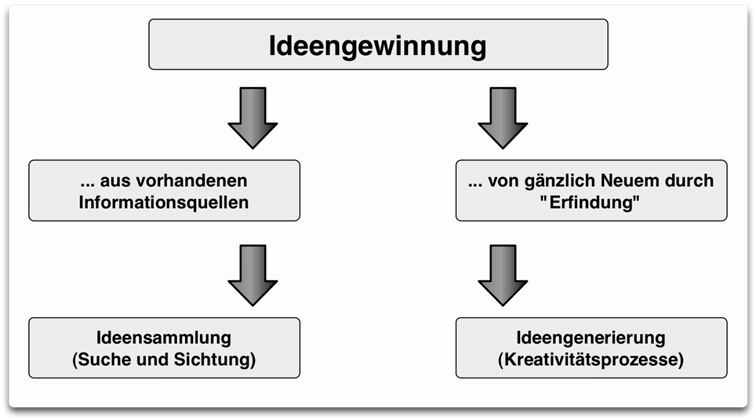
Figure 37: Obtaining ideas [Vahs 2005]
Idea collection draws on existing solution approaches, which conserves a company’s resources. Idea generation, by contrast, uses creativity and “invents” something new, often with greater future potential. Both methods can be used to find new, innovative ideas. [Theile-Schürholz 2008]
The process of idea generation and the active creation of new solution approaches are significantly supported by the use of creativity techniques. The fundamental aim is to improve and secure the company’s capacity for innovation. [Gausemeier et al. 2001]
1.1.1 Definition of creativity
The term creativity is now applied to industry and business as well as to many other fields concerned with human performance. Nevertheless, there is no unambiguous definition. [Schlicksupp 1998]
Creativity comes from “creare”. This is Latin and means “to create”. Creativity is also understood as creative potential that enables people to arrive at innovative and new ideas by seeing new relationships, bringing existing thoughts together and thinking creatively. [Mencke 2006]
1.1.2 The thinking process
Edward De Bono found that in standard situations the main pathways of thinking are used (see Figure 38). In everyday situations this linear or vertical thinking is necessary. When searching for new and alternative solutions, however, this standard way of thinking holds us back, because it always leads to the same, already known solutions [Novak 2001]. It is important to break out of entrenched patterns and to stimulate the flow of ideas through creative thinking and altered thinking structures [Mencke 2006]. This so-called lateral thinking leads to innovative solutions [Pepels 2006].
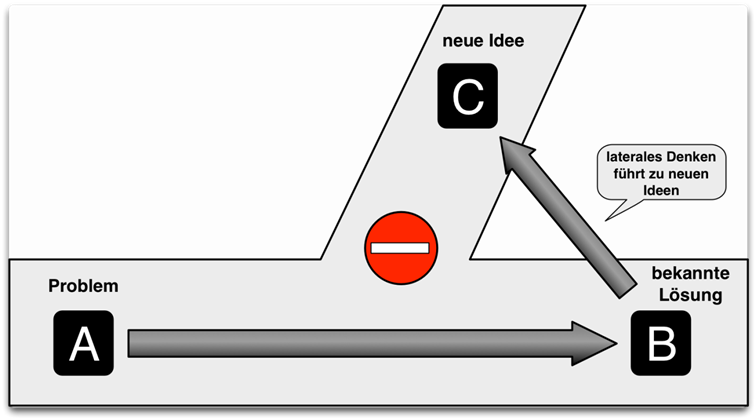
Figure 38: Lateral thinking [Gausemeier et al. 2001]
Every person has a natural creativity, which is used to varying degrees. External influences can encourage its use, but can also prevent it [Gausemeier et al. 2001]. So-called creativity barriers, such as fear, embarrassment or premature evaluation, often prevent one’s own creativity from developing fully.
Creativity techniques make it possible to use the potential of this suppressed creativity for innovative solutions. [Vahs 2005]
1.1.3 The creative process
The sequence of problem-solving processes that leads step by step from a problem to a novel solution idea constitutes the creative process [Lindemann 2005]. Today there are various models which, depending on the author and level of detail, are made up of different phases. The 4-phase scheme according to Schlicksupp is considered below. He divides the creative process into the following phases.
- Preparation
- Incubation
- Illumination
- Verification
The preparation phase serves to recognise the problem and then analyse it systematically. All aspects of the problem are set out transparently. In this way, the knowledge needed for the solution is prepared and acquired.
The incubation phase serves to internalise the problem. Here, the thinking processes take place mainly in the subconscious. As the person searching for ideas unconsciously tries to combine the problem with their own experience, they are able to develop new solution approaches. This is also referred to as “subconscious problem processing”, since solution approaches can develop even when the person concerned is not directly occupied with the problem at all.
Enlightenment, or illumination, serves to deliver the solution approaches from unconscious thinking. When the person searching for ideas has a sudden “flash of inspiration”, they become aware of the idea and can bring it forth.
In the final phase, verification, the idea is checked and analysed. Here, consideration is given to whether the solution meets the requirements of the problem. [Schlicksupp 1998]
In everyday life, the creative process takes place whenever we deal with a problem. Since this process runs very slowly, finding a solution in this way takes a relatively long time. Creativity techniques accelerate and additionally support each individual stage of this process [Lindemann 2005]. Creativity techniques are based on a basic scheme of the creative process, which is followed as the technique is worked through [Vahs 2005].
1.2 Creativity techniques in Value Analysis
Creativity techniques are used to stimulate the flow of thought and encourage idea generation. They are based on heuristics. These are strategies and methods that make it possible to find solutions to problems by looking at them from a different angle [Schlicksupp 1998]. Examples of heuristic principles applied in creativity techniques are variation, association, combination or the formation of analogies [Geschka 2004].
Alex Osborn laid the foundation for creativity techniques in the late 1930s with brainstorming. Today more than 100 different methods are known. [Albers et al. 2005]
There are numerous attempts to systematise the various creativity techniques, in which the methods are arranged in a scheme according to different criteria. According to Schlicksupp, this classification is based on heuristic principles (see Figure 39). A distinction is made as to whether the heuristics promote the problem solution itself in a systematic way or stimulate intuition and creativity. [Schlicksupp 1998]
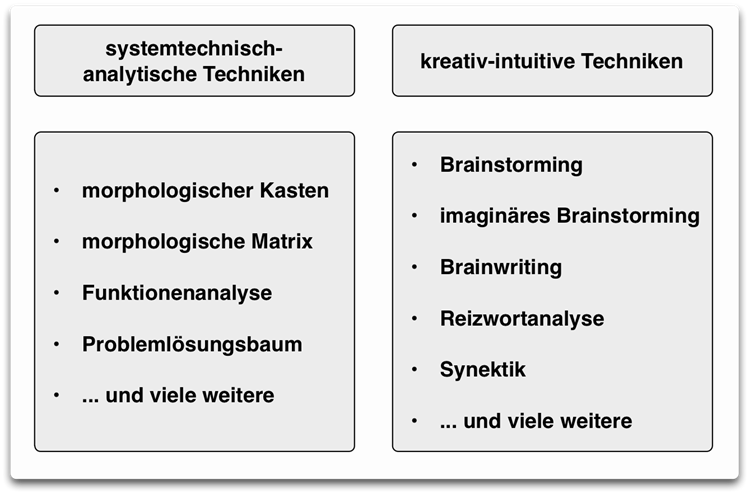
Figure 39: Classification of techniques by heuristics [Schlicksupp 1998]
However, many creativity techniques cannot be clearly assigned, as they combine different principles. They have both an intuitive and an analytical character. Classification into different groups of methods is therefore only possible to a limited extent. [Neumann 2003]
Below, the creativity techniques are structured according to a systematisation by Wack [Wack 1998]. This is based on the following principles.
- Principle of free association
- Principle of random stimulation and the stimulus word technique
- Principle of systematic variation of conditions
- Principle of imagery and analogy
1.2.1 Principle of free association
The principle of free association is based on not restricting the flow of thought. Once the problem has been precisely defined, free association is used to look for aspects that are in some way connected with the problem. These are usually familiar aspects. By forming new combinations and assignments of the associations through different thinking patterns, the participants develop new solution ideas. The following creativity techniques promote mutual intellectual stimulation among participants during a team session. [Wack et al. 1993]
1.2.1.1 Brainstorming
Brainstorming is probably the best-known creativity technique. It was developed in the USA in the 1950s by Alex Osborn. It is characterised by reciprocal free association in a team that is usually cross-functional. Brainstorming stimulates an intensive flow of ideas among the participants, with the proposals already made by the team being used as prompts for further ideas. [Scherer 2007]
However, true to the motto “quantity before quality”, a very large number of possible solutions is usually developed, which often only helps with problems for which it is very easy to generate many different solutions without the specialist knowledge this would otherwise require. The ideas are developed further while avoiding criticism and premature evaluation during the session. [Osborn 1957] [Zobel 2007]
Below, some variants of brainstorming that have evolved over time are briefly discussed.
1.2.1.1.1 Imaginary brainstorming
Imaginary brainstorming was presented by Arthur F. Keller and is based on classic brainstorming. Creativity, imagination and originality are extremely important here. By leaving their usual thinking patterns and finding fictitious, unrealistic and crazy solution approaches for modified, imaginary problems, participants can later transfer the imaginary problem back to the original problem and use the solution approaches found in the search for solutions. [Schlicksupp 1998] [Keller 1971]
1.2.1.1.2 Reverse brainstorming
Reverse brainstorming is a variation of imaginary brainstorming. The idea behind this technique is that reversing the formulation of an issue can help to overcome mental blocks and prejudices. It is easier to generate nonsensical answers to nonsensical questions than to find solutions to real problems directly. In this technique, solutions are sought for the inverted question. Afterwards, an attempt is made to transfer these negated solutions back to the actual problem. More innovative solutions can be found and blocks can be removed. [Kellner 1999] [Rawlinson 1980] [Werner 1975]
1.2.1.1.3 Anonymous brainstorming
In anonymous brainstorming, participants’ ideas are produced anonymously and then presented and discussed by a facilitator in a subsequent team session. This means that quiet and shy employees also take part in the creative process and do not hold back ideas for fear of embarrassment. Anonymous brainstorming combines the advantages of individual and group work. [Schlicksupp 1977] [Simon 2007]
1.2.1.2 Brainwriting
Brainwriting is a further development of brainstorming in which all ideas are written down. Because the ideas are recorded in writing, the facilitator cannot “distort” the proposed solution [Vahs 2005]. Verbal communication can largely be dispensed with in this format. However, participants still interact by exchanging their notes [Bayerl 2010]. Over time, different sheet formats and different ways of exchanging them have changed brainwriting methods to such an extent that several variants now exist. [Silverstein et al. 1965]
The most important ones are described below.
1.2.1.2.1 6-3-5 Method
The best-known form of brainwriting is the 6-3-5 method. It was developed in 1969 by the management consultant B. Rohrbach. Six people each write down three ideas within five minutes. The sheet is then passed on clockwise, and the next person adds three more ideas to their predecessor’s sheet [Bayerl 2010]. Existing solution approaches are meant to serve as associative prompts for further ideas. [Blumenschein 2002] [Rohrbach 1969]
1.2.1.2.2 SIL method
SIL stands for “Sukzessive Integration von Lösungselementen” (successive integration of solution elements); the method was developed by H. Schlicksupp. Once participants have developed initial ideas individually, different ideas are linked to produce an outstanding overall solution. [Schlicksupp 1977]
1.2.1.2.3 Collective notebook
The collective notebook method is a slightly modified form of brainwriting. Selected participants use a notebook over a certain period to jot down, spontaneously and in the course of their daily work, whatever occurs to them about a previously defined problem [Backerra et al. 2002]. In this way, idea generation is not tied to a team meeting but can take place at any time, including in everyday life. At a set point, a project team or facilitator collects, evaluates and summarises the notebooks. If required, the summarised solution ideas can later be redistributed to the participants so that they can continue working on the solutions developed so far. [Clark 1973]
1.2.1.2.4 Delphi method
The Delphi method is a multi-stage survey of selected experts that uses a questionnaire (with open and closed questions) to obtain forecasts of future developments [Lindemann 2005]. The experts are asked for their opinions, ideas and recommendations by email in successive survey rounds. Ultimately, the aim is to arrive at a shared group opinion as the experts’ views converge. Delphi surveys can also be used to aggregate ideas and thus help to develop initial proposals for solving a problem. [Häder 2002] [Helmer 1967] [Kaufmann et al. 1972]
1.2.2 Principle of random stimulation and stimulus word technique
To stimulate the creative solution process, these methods use randomly selected or randomly combined terms. Terms chosen at random are analysed, associated and combined, which generates new solution ideas. [Wack et al. 1993]
1.2.2.1 Stimulus word analysis
Stimulus word analysis is one of the confrontation techniques and was developed by H. Geschka and G. Schaude at the Battelle Institute in Frankfurt [Schröder 2005]. Associations are noted for each of ten stimulus words chosen at random from an encyclopaedia, yielding possible solutions that can be applied to the original problem. This deliberately supported lateral thinking enables a change of perspective and favours innovative solutions. [Scherer 2007]
The authors Schlicksupp and Schröder describe a different approach. They skip the phase of free association and have the team analyse and examine the stimulus words directly in terms of different elements, such as functions, properties or structures. The resulting statements are then related back to the problem. The more flexibly and imaginatively this is done, the more varied and creative the solution approaches can be. [Schlicksupp 1998] [Geschka H. 1980]
1.2.2.1.1 Force fit game
The force fit game is a variant of stimulus word analysis. Here, too, the problem is made unfamiliar with the help of stimulus words. Two parties take turns, under time pressure, to name solution approaches to the existing problem in response to randomly called-out stimulus words, which produces creative ideas. These solution approaches can be evaluated and analysed later. [Wack et al. 1993]
1.2.2.1.2 Encyclopaedia method
The encyclopaedia method is similar to stimulus word analysis. A randomly selected encyclopaedia entry is meant to prompt participants to make free associations, which are later transferred to the initial problem. [Mencke 2006] [Winkelhofer 2006]
1.2.2.2 Semantic intuition
Another method that also uses stimulus words to find solutions is semantic intuition, also known as the semantic method. Twenty terms generated by spontaneous association are combined in pairs at random and written one below the other [Winkelhofer 2006]. These terms evoke mental images in each participant that can be turned into new solution ideas for the original problem. [Schröder 2005] [Schlicksupp 1998] [Wack et al. 1993]
1.2.3 Principle of systematic variation of conditions
This heading covers all methods characterised by a systematic approach to the search for solutions. Either an aspect of the problem situation or a fundamental factor of the previous solution search is varied in different ways. [Wack et al. 1993]
1.2.3.1 Checklists
A checklist is a list of questions about an existing problem. Using these questions, the user broadens the problem field and forms analogies and new associations in the search for a solution, arriving at an innovative solution. [Neumann 2003] [Backerra et al. 2002]
It is particularly helpful to use checklists in combination with common creativity techniques, as they stimulate creativity and encourage intuitive ideas [Lindemann 2005]. Even though general checklists and question catalogues are not referred to as creativity techniques in the literature, they nevertheless help to analyse problems and support a systematic approach [Neumann 2003].
1.2.3.1.1 Osborn checklist
Starting from the observation that most teams often look at a problem from only one particular angle, Alex Faickney Osborn developed a checklist of questions divided into nine different categories. As the questions are worked through in order, each participant comments on every question in relation to the original problem. [Mencke 2006] [Winkelhofer 2006] [Osborn 1957]
1.2.3.1.2 Clicking question catalogue
Another checklist is the Clicking question catalogue, which provides a collection of thinking strategies based on more than 200 questions. Mario Pricken himself describes his creativity technique as “…a toolbox from which you can keep taking new brain tools to systematically expand your own thinking strategies.” [Pricken 2001]
1.2.3.2 Morphological box
The Swiss astrophysicist Zwicky developed the morphological box method. A classification scheme is used to analyse and structure a problem by first breaking it down into its individual functions or components. Possible solutions are then sought for each of these individual parts. The partial solutions developed are later combined systematically to obtain a large number of different overall solutions to the problem. Vertical thinking plays a major role in the morphological box, producing a wide range of alternatives [Hauschildt 2004]. Based on a schematic representation, idea generation is approached in a highly systematic way [Nöllke 2006]. It can also be described as a “total solution system” that contains all possible solutions in one classification scheme. [Zwicky 1971] [Marr 1973]
1.2.3.2.1 Morphological matrix
The morphological matrix is very similar to the morphological box. It is also known as the “morphological tableau”, “problem field analysis” or “insight matrix”. However, it considers only two important elements of the problem and their characteristics. A matrix is developed step by step that gives the problem solver a clear overview of all possible ideas for the respective problem fields. [Schröder 2005] [Kaufmann et al. 1972]
1.2.3.2.2 Attribute listing
The attribute listing method, developed by Robert C. Crawford, starts directly from the existing product, process, etc. It examines characteristics that can easily be changed. Close examination and analysis of the current state of these characteristics (attributes) gives rise to suggestions for improvement. Combining and systematically varying the attributes creates new possible solutions. [Albers et al. 2005] [Tiemeyer 1997] [VanGundy 1988]
1.2.3.3 Progressive abstraction
The progressive abstraction method was developed by Horst Geschka. Its purpose is to work out the underlying causes of a problem. The question “What is this really about?” plays a major role. To get systematically to the core of the problem, it is split into sub-problems. The resulting distance from the original problem makes new solution ideas possible. [Backerra et al. 2002] [Geschka H. 1980]
1.2.3.4 TILMAG method
TILMAG stands for “Transformation idealer Lösungselemente in Matrizen zur Bildung von Assoziationen und Suche von Gemeinsamkeiten” (transformation of ideal solution elements into matrices to form associations and identify commonalities). Ideal solution elements are formed and brought together in an association matrix. Combining them produces new solution ideas, which in turn are summarised in a commonality matrix. The team continues to develop the ideas until an optimum solution emerges. [Schröder 2005] [Schlicksupp 1977]
1.2.3.5 De Bono’s Thinking Hats
The creativity researcher Edward De Bono developed the six thinking hats method. With this method, those searching for ideas look at the original problem from different points of view [Gillies 2003]. The hats symbolise the different modes of thinking, which are adopted one after the other by figuratively putting on each hat.
Work under the white hat is neutral. Figures, data, facts and other known information are gathered. No opinions are formed and nothing is evaluated.
The red hat stands for feelings and intuition, which should be expressed freely.
Under the black hat, statements, problems, errors and critical views must be named and justified logically. The black hat is the counterpart to the red hat.
The yellow hat shows only positive views and advantages. It represents the most difficult mode of thinking. Only the advantages, benefits and value of the idea are to be sought and justified.
Under the green hat, creative solution proposals are to be developed and innovations found. Statements made in this phase do not need to be justified.
The blue hat takes the objective, overarching view that provides orientation during the discussion. Under it, decisions are made and the next steps are considered.
The six thinking hats method can be applied in different ways. A team meeting can use just one hat or all the colours in a predefined order. The hats can also be used when working individually. [Novak 2001] [Scherer 2007] [De Bono 1989] [De Bono 1990]
1.2.3.6 Walt Disney Method
This method goes back to Walt Disney and later became known through Robert Dilts as “Disney’s thinking chairs” or the “Walt Disney strategy”. Like De Bono, it works with different modes of thinking and changes of perspective [Nöllke 2006]. Walt Disney set up three rooms for the perspectives of dreamer, realist and critic, each furnished with a matching atmosphere [Blumenschein 2002]. Moving between the rooms, and the different basic attitudes, emotions and perspectives this creates, produces a wide variety of new ideas and solutions. [Dilts et al. 1994]
1.2.3.7 Mind map
Tony Buzan developed the mind map in 1970, basing it on the way the human brain works. On the one hand, the mind map supports the structuring and visualisation of problems; at the same time, it encourages leaps of thought and spontaneous thinking. A mind map breaks the problem down in writing and pictures [Mencke 2006] into different elements and visualises it on different levels of abstraction. [Backerra et al. 2002] [Lindemann 2005] [Buzan 1997]
1.2.3.8 TRIZ
The scientist Genrich Altshuller laid the foundations of the TRIZ method in 1948. TRIZ is a Russian acronym meaning “theory of inventive problem solving”. From an analysis of 2.5 million patent applications, Altshuller identified three essential patterns in particularly significant inventions [Mencke 2006].
- A large number of inventions are based on a comparatively small number of general solution principles.
- Only overcoming contradictions makes innovative developments possible.
- The evolution of technical systems follows certain patterns and laws.
Altshuller used these findings to develop various TRIZ tools. The versatile toolbox of the TRIZ method therefore provides particular support for idea generation, which is regarded as the seed of innovation. When TRIZ is used, especially in innovation management, the search for new solutions to problems becomes more systematic, more efficient and much faster. [Schweizer 2005] [Walter 2005]
Altshuller also found that the contradiction is the central element of an innovative invention. It is an essential step in analysing problem structures, as it helps to identify and describe problems. In the technical field in particular, TRIZ offers many helpful approaches and methods for finding solutions to problems [Mencke 2006]. The 40 inventive principles, also referred to as invention methods, help to overcome technical contradictions. For example, principle no. 1, “segmentation”, is used to check whether a possible solution becomes apparent. [Walter 2005] [Altschuller 1986]
1.2.3.9 Systematic inventive thinking
Systematic Inventive Thinking (SIT), by Jacob Goldenberg, is based on the TRIZ method. However, it consists of only five basic patterns. This reduced body of material makes it easier to apply. The five patterns are briefly explained below. [Obermeier 2005] [Goldenberg et al. 2003]
Division
Division often leads to a new benefit of the product, or reveals new marketing opportunities. The individual components of a product are grouped according to their functions, as in a hi-fi system individually assembled from speakers, tuner and similar components.
Subtraction
Subtraction is the most frequently used of all the thinking tools. Components of an existing product are simply removed, as in the development of alcohol-free beer. Markets and target groups for the newly created product often only emerge after some time.
Multiplication
Multiplication duplicates suitable existing components of a product in such a way that the existing product becomes qualitatively better, for example turning the single blade of a razor into a multi-blade razor.
Task unification
The basic pattern of task unification links individual components of an existing product. The question is which components can be eliminated if others take over their task. In some cars, for example, the heating wire also serves as an aerial.
Attribute dependency
Here an existing relationship is redefined, for example the relationship between quantity of food and price in “all you can eat” offers. [Obermeier 2005]
1.2.4 Principle of imagery and analogy
The following methods use mental images or analogies to stimulate new solution approaches. Looking at the problem from new angles or forming analogies to it can give rise to new solution ideas. [Wack 1998] [Daenzer 2002]
Figure 40 shows the principle of forming analogies.
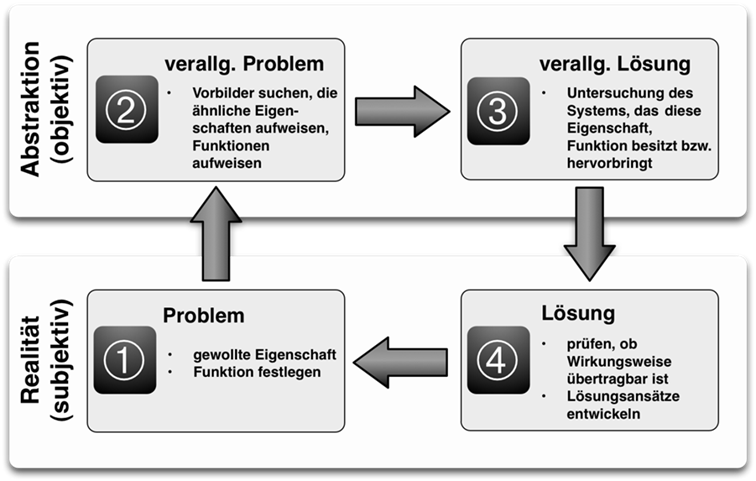
Figure 40: Forming analogies, based on [Daenzer 2002]
1.2.4.1 Synectics
This four-phase method was developed by the American W.J.J. Gordon. It seeks to intensify the search for a solution to a problem through step-by-step analogy formation [Daenzer 2002]. To support the process of making the familiar strange, analogies from a wide range of fields are used. Synectics tries to increase the distance from the original problem in order to break away from vertical thinking. [Gordon 1961]
The phases are as follows.
Preparation phase
In this phase, the problem is analysed in detail and team members’ questions of understanding are clarified.
Incubation phase
This phase focuses on gaining distance from the problem in space and time. Through a sequence of different analogies, the team moves further and further away from the original problem. The following sequences of analogies can be used.
- Direct analogy
Direct analogies are sought, together with problems in these analogies that are comparable to the original problem. The analogies can come from nature, technology or other areas of reality. Comparable problems or structures (elements, processes) in this unrelated field make new solution ideas possible.
- Personal analogy
Participants identify with the object by asking themselves “How do I feel as…?”; forming these personal analogies makes the direct analogies even more unfamiliar.
- Symbolic analogy
Here contradictions are formed, for example “whispering scream”. Wherever possible, only contradictory adjectives and nouns should be used. In this way, further symbolic analogies are formed from the personal analogies.
- Direct analogy
The process of making the problem unfamiliar is completed by linking the symbolic analogy to another area of reality through a second direct analogy. This can be an area such as technology, nature, history, politics or economics.
Illumination
After a thorough analysis of their distinctive structural features, the analogies from the last stage are now related back to the original problem. In the form of a force fit, the features are transferred to the original problem with a degree of force. In this way, spontaneous solution ideas become visible.
Verification phase
In this final step, the solution approaches that have emerged are checked for usefulness and developed further where necessary. [Hauschildt 2004] [Werner 1975] [Marr 1973] [Adams 1984]
1.2.4.2 Visual synectics
In the literature, visual synectics is also referred to as visual confrontation. It is a variation of classic synectics. Visual stimuli such as pictures, photos, drawings, etc. are used to create distance from the problem. New associations are transferred to the original problem and contribute to innovative solution ideas. [Winkelhofer 2006] [Schlicksupp 1977] [VanGundy 1988]
1.2.4.3 Bisociation
The main feature of bisociation, a term coined by Arthur Koestler, is the bringing together of two completely unrelated “dimensions of thought” [Nöllke 2006]. After a detailed definition of the problem, the search begins for the second “dimension of thought”, which is meant to help solve the problem. This can start with questions about similarities or with a search for other fields, for example: “What is similar to what we want to achieve?”, “In which field does what fails here actually work?”. Ideas for new and innovative solutions can be found both in unrelated and in closely related fields. The next step is to look for analogies, common principles or structures that can be transferred to the original problem. [Nöllke 2006] [Koestler 1966a] [Koestler 1966b]
Wack describes an extension of bisociation in which he supports the process with randomly selected images. These encourage new thinking patterns and give rise to fresh ideas. The aim is to transfer new patterns, structures and special features of an image to the original problem in order to find new, creative solution proposals. [Wack 1998]
1.2.4.4 Bionics
The term Bionik (bionics) was first coined by J. Steele in 1960. The German term Bionik combines Biologie (biology) and Technik (technology).
Bionics cannot be equated with the creativity techniques described above. Bionics is a scientific discipline that uses ideas from nature for technical developments. The polar bear, for example, is often used as inspiration for new technical developments. Besides copying the non-slip soles of its paws, which developers already use to produce winter tyre treads, the structure of its fur is also being copied for the latest inventions in solar energy generation [Spilok 2006]. Biological systems reproduce, regulate and optimise themselves [Hill 1999]. They are based on the principle of self-organisation. In this respect, nature offers many more designs and processes that can serve as models for outstanding technological achievements [Nachtigall 2000]. Biological systems ensure functional reliability and system stability, yet use only a minimum of energy and material while still achieving the maximum of their vital functions [Cerman et al. 2005]. Because biological systems have been able to evolve and optimise themselves over millions of years, they are highly efficient. For this reason, they offer a broad range of solution approaches. [Von Gleich 1998] [Rechenberg 1994] [Marguerre 1991]
1.3 Which creativity technique should I use in Value Analysis, and when?
In practice, the question often arises as to which creativity technique should be used. The choice of the best method depends essentially on two criteria: the characteristics of the problem and the general conditions. [Schlicksupp 1998] Table 15 compares the individual creativity techniques on the basis of the characteristics described below.
1.3.1 Problem characteristics
Complex problems
The complexity of the problem and the type of problem at hand play an important role in the search for a suitable method [Schlicksupp 1998]. Problems can often be divided into simple and complex problems. Simple problems can usually be solved with intuitive, creative methods [Schlicksupp 1998], whereas complex problems are better suited to analytical, systematic methods. Here, new ideas are generated through systematic development. New ways of solving the problem are also often found by combining partial solutions. [Schröder 2005]
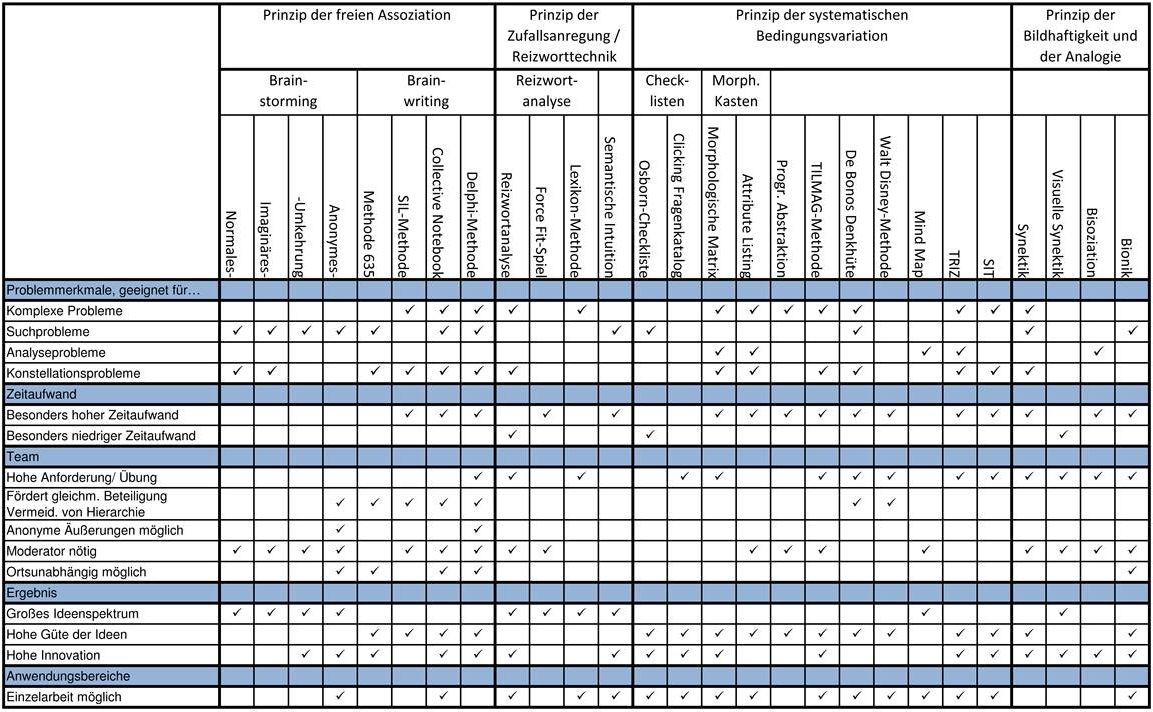
Table 15: Classification of creativity techniques
Another option is to classify problems by the type of thinking they require. There are five types of problem.
Search problems
Search problems are characterised by the fact that known solutions can be used to solve them. The difficulty lies in finding the known solution. Various search criteria can help in the search process.
Analysis problems
A distinctive feature of analysis problems is that solving them requires a complete and correct analysis of the problem structure [Schröder 2005]. Only then can the relationships between the structural elements be clarified and solutions found [Mencke 2006].
Constellation problems
Constellation problems typically have a complex structure. They must first be broken down into sub-problems. Combining the partial solutions found ultimately produces an overall solution to the problem. [Schröder 2005]
Selection problems
With selection problems, the focus is on combining the different characteristics. Several different partial characteristics are often mutually exclusive.
Consequence problems
With consequence problems, known laws are followed, and a solution is reached in this way.
These five types of problem fall into two categories: well-structured problems and poorly structured problems. Selection and consequence problems belong to the category of well-structured problems. They can be solved reliably by algorithms in a logical and systematic way. Creativity techniques are less suitable or not needed for them [Backerra et al. 2002]. These problems usually have only one optimum, demonstrable solution [Mencke 2006]. For this reason, selection problems and consequence problems are not considered further as criteria in Table 15.
Creativity techniques are, however, of great importance for the undirected and intuitive search for solutions to poorly structured problems [Schlicksupp 1998]. Poorly structured problems often have a large number of possible solutions. Creativity techniques are used to develop original and creative ideas, and the optimum solution is ultimately selected. [Mencke 2006]
1.3.2 General conditions of the problem-solving situation
Another important aspect is the different general conditions that a problem-solving situation entails. The right method can only be chosen once it is known under which conditions the problem is to be solved. [Schlicksupp 1998]
Both time and the team play an important role here.
Time
Some techniques take more time than others.
Team
As creativity techniques are often used in a team, the methods chosen should be matched to the existing team and its circumstances.
Requirements/practice
In principle, some creativity methods can be applied immediately without any prior knowledge on the part of the participants. Other methods, however, are quite demanding, and it is advisable to practise them with the team before using them.
Equal participation and avoidance of hierarchies
Internal problems within the team can be another problem factor in creativity sessions. These arise when participants with different positions in the company, or with different native languages, work together. It is equally difficult when a team is very heterogeneous, so that very shy employees meet very dominant ones. This can also be addressed by choosing specific creativity methods.
Anonymous contributions possible
Where such problems are very serious, it can make sense to use creativity techniques that allow ideas to be put forward anonymously.
Facilitation required
An external facilitator to coordinate and facilitate the team is not always essential, but is nonetheless often advisable. With some creativity techniques, it can be dispensed with.
Location-independent
Some methods allow the participants in the creativity session not to be gathered in one place, or at least not all the time.
1.3.3 Result
An important criterion for choosing a creativity technique is the result it produces. Depending on the type of thinking process addressed, the results differ in the number and quality of ideas.
Broad range of ideas
The creativity techniques in this category usually produce a large number of solutions. These may be new or even revolutionary, but are often also impracticable or outside the scope of the task. A distinctive feature of these techniques is that, because of the large number of solutions, the quality of the ideas can only be low. They must be developed further in a subsequent step.
High quality of ideas
Through intensive work on the problem, the creativity techniques in this category tend to generate fewer but higher-quality solutions.
Innovation
Not every creativity technique is suitable for creating something genuinely new. Depending on the type of thinking a method stimulates, and how intensively, the novelty of the idea can vary greatly. Creativity techniques that are suitable for genuine innovations are listed under this criterion.
1.3.4 Areas of application
Individual work
Another distinguishing feature is the area of application. In general, all creativity techniques can be used in teamwork. The techniques in this category can also be used for individual work as well as in teams.
1.4 Summary: creativity in Value Analysis
Knowing which problem characteristics and general conditions apply in a specific project, you can use Table 15 to estimate which creativity technique is most appropriate. The short descriptions of the creativity techniques provide an initial overview of how each one works. The literature cited makes it easy to study the relevant techniques in more depth. This ensures that interested users can easily identify and apply further suitable techniques beyond those they already know.
This text and the images are protected by copyright.
Reprinting and any further use (including extracts) require the written permission of Value Coaching Marchthaler.
Source: